Адаптація дитини до школи: як підтримати її в перші тижні навчання
Let’s start with a slightly sad piece of news for parents: no matter how much we would like to, we cannot protect our children from life.
They will meet people they do not like, someone will eventually say something unpleasant to them, they will have arguments, they may get a grade they think is unfair, they may come across a teacher they find difficult, and they will definitely have to do things they simply do not feel like doing.
A child’s life, just like an adult’s, will include disappointment, competition, conflict, the need to adapt, wait, negotiate, and sometimes do things not because they want to, but because they have to.
And that does not mean you have failed to take good care of your child.
It is impossible to place your lovely little flower in a greenhouse where there is never any wind, nobody ever says anything hurtful, and every adult around them is exceptionally wise, emotionally regulated, and perfectly suited to their role.
And, to be honest, such an environment would probably not help them learn how to deal with real life anyway.
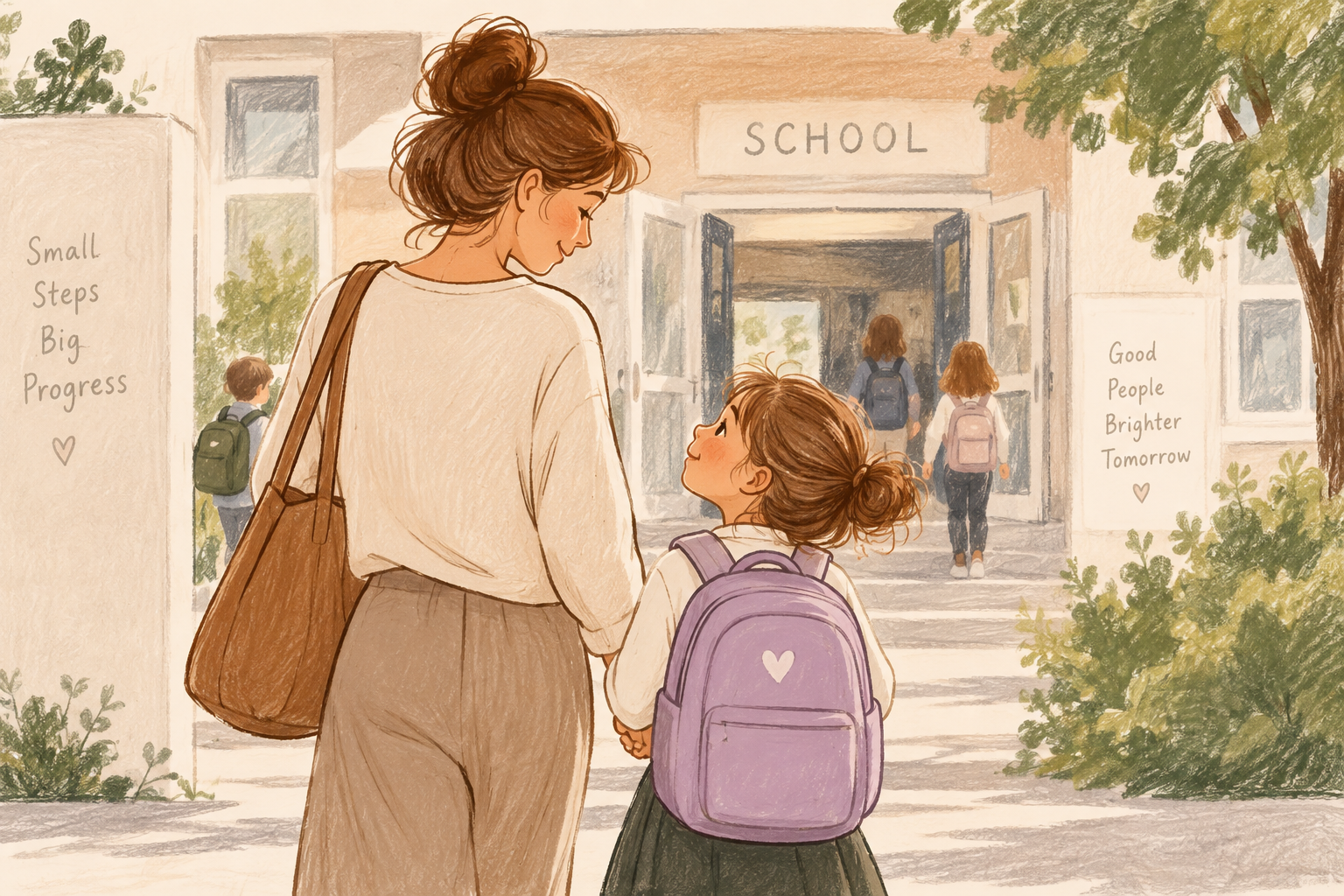
So, as I see it, a parent’s job is a little different: not to deal with every difficulty instead of the child, but to stay close and gradually help them learn how to manage those difficulties themselves. This becomes especially important during a child’s adjustment to school.
Not every problem requires an immediate rescue mission
Imagine your child comes home from school and says, “I hate this teacher. She’s stupid.”
Parents can very easily swing toward one of two opposite reactions.
The first sounds something like: “How can you talk about your teacher like that? Stop making things up, she’s perfectly fine. Go and do your homework.”
The second is: “What?! Did she say something to you? That’s it, I’m going to the principal tomorrow.”
And both reactions can make it harder to understand what actually happened.
Containing a child’s emotions does not mean agreeing with everything they say. If your child says, “The teacher is stupid,” you do not have to respond, “Yes, yes, absolutely, she’s a terrible person, you’re never going back there.”
But you also do not need to convince your child that they have no right to feel the way they do.
You can simply say, “I can see you’re really angry. Tell me what happened.”
In other words, we allow the child to feel what they feel, even when we think the reaction is exaggerated or that they are not yet seeing the situation objectively.
You are allowed to be angry with your teacher, you are allowed to feel hurt, you are allowed to think something was unfair, and right now you are even allowed to say that you hate the whole school.
Then we can take a calmer look at what is actually behind that reaction.
Maybe the teacher said something the child experienced as unfair. Maybe the teacher did not hear their explanation. Maybe classmates made a joke that did not land well. Maybe the child did something themselves and now finds it difficult to acknowledge their share of responsibility. Or maybe this really is a situation where an adult needs to step in.
The important thing is not to stop at the emotion, but also not to leap over it and go straight into problem-solving.
It is useful for a child to gradually learn something quite simple: difficulties happen, strong emotions about those difficulties are normal, and once we have been angry, upset, or had a chance to vent a little, we can think about what to do next.
Sometimes it helps to show children that adults live in roughly the same world
Simple examples from your own life can be very useful here.
You might say, “Something happened at work today that made me really angry. I came home, talked it through a little, spoke to a friend, calmed down, and then thought about how I’m going to deal with it tomorrow.”
Of course, you do not need to turn your child into your psychotherapist and give them every detail of your conflicts with your boss.
But it is useful for children to see that adults do not live in a world where they always like everything and everyone is always fair.
Adults also get angry and disappointed, sometimes feel that they have been treated unfairly, and can come home saying, “Honestly, I don’t want to see any of those people tomorrow.”
And then they live through the emotion, calm down a little, and decide what to do next.
That is the kind of experience we can gradually pass on to a child.
What if it were your friend instead?
I also like this little test for parents.
Imagine that a close friend has changed jobs and, after a week, comes to you saying, “Everything is awful. I don’t like the team, my manager irritates me, and I honestly don’t want to go back tomorrow.”
You probably would not immediately say, “Oh, come on. Your office has a sea view. What could you possibly be unhappy about?”
Most likely, you would listen first, even if somewhere inside you thought your friend was being a little dramatic or that the situation was not really that terrible.
You would let them explain what happened, what upset them, what they are afraid of, and why they are so angry.
Sometimes it is very useful to look at your child in exactly the same way.
Their difficulties may seem tiny, silly, or completely blown out of proportion to us, but to them they are real right now.
And I think it matters to treat those experiences with the same respect we usually give to the feelings of adults we love.
Don’t add all twenty-eight extracurricular activities on September 1
One practical thing that can genuinely make adjustment easier is increasing the workload gradually.
At the beginning of the school year, it is very tempting to organise a beautifully productive schedule straight away: school, English, maths, dance, swimming, art, chess, tutoring, music, cross-stitching, and something else for the harmonious development of the whole personality.
Meanwhile, the child has not even fully adjusted to the fact that they now have to wake up every morning and go to school. That is why the first weeks at school may not be the best time to immediately add the maximum possible amount of extra activity.
If your family has the option, it is better to add extracurricular commitments gradually. For example, you can let the child spend the first week or two simply getting back into the school routine, then add one activity, and add something else a little later.
That does not mean all extracurricular activities need to be cancelled or that your child should spend the whole of September lying on the sofa.
I understand the practical side of parents’ lives perfectly well. People work, not everyone has grandparents nearby, and sometimes after-school care, a club, or another activity is necessary not only “for development” but also because the child needs to be somewhere safe and occupied while the adults are working.
There is nothing wrong with that.
It is simply useful to be honest with ourselves about what function a particular activity serves and, wherever there is genuine room for choice, not to pile everything on at once.
Because a week ago the child may have been sitting happily in the shade on the beach, swimming in the sea and perhaps reading a book at most, and now suddenly it turns out they have a full-time job and an evening shift afterwards.
Ask about more than grades
There is a classic conversation that I think almost every family knows.
“How was school?”
“Fine.”
“What did you get?”
“Nothing.”
And with that, meaningful family communication ceremoniously comes to an end.
If you remember your own childhood, questions about grades often did not feel like genuine interest in our lives. They felt more like an inspection: did you perform your role as a student properly today or not, are you about to be praised or is somebody going to start fixing you?
So sometimes it is much more interesting to ask what was funny today, who they had a good conversation with, whether there was a situation where they did not know what to do, what upset them, or what was the hardest part of the day.
Of course, you should not expect your child to immediately produce a beautiful fifteen-minute reflection on their feelings and the social dynamics of the classroom. They may say, “I don’t know,” shrug, or simply go and get something to eat.
But the quality of the relationship gradually changes when the child sees that you are interested not only in the outcome, but also in how they are actually experiencing their life.
And I think that kind of connection is far more important than knowing every grade three minutes after it has been given.
Because when children get used to the idea that you are interested in more than their performance, they are much more likely to come to you when something genuinely important happens.
“We’ve done everything for you” is probably best left out of the argument
Parents really do a huge amount.
They look for schools, drive children to different activities, buy nice new things, arrange tutors, pay for lessons, worry, think about how to make things better, and often try to give their child opportunities they themselves never had.
And that is exactly why it can hurt so much to hear, “I hate this school,” or, “I don’t want to go there.”
It becomes very easy to say, “Do you even understand how much we’ve done for you?”, “We found you the best school,” or, “When I was your age, I didn’t have anything like this.”
The problem is that the child may hear a completely different message.
Not, “I tried really hard for you,” but, “So much has been done for me that I no longer have the right to feel bad.”
Or, “If I tell Mum that I don’t like something here, she’ll be upset, so next time I’d better keep quiet.”
It can be completely true that you have done a great deal for your child.
And it can also be completely true that your child is having a hard time in this wonderful school right now.
One does not cancel out the other.
What was your own school experience like?
It can also be useful to remember your own school years. If you were bullied at school, you may react much more strongly to a conflict between your child and their classmates.
If you had a teacher who humiliated children, one sharp comment from your child’s teacher may immediately bring up a lot of your own fear or anger.
If grades were extremely important in your family, one poor grade may trigger so much anxiety that it feels as though your child’s entire future is being decided right now.
That does not mean a parent’s feelings are wrong or should be ignored.
It is simply useful to remind yourself from time to time that my experience is my experience, and my child’s experience may be completely different.
Not every conflict is the beginning of the same bullying you once went through, not every strict teacher is a psychopath who abuses children, and not every situation will end the way something similar once ended for you.
Sometimes it is worth simply asking yourself: am I reacting to what is actually happening to my child right now, or am I also reacting to something from my own history?
Sometimes a child just needs a cup of tea
And perhaps one of the simplest but most important things is that a child should not have to come home from school every day only to enter a second office where the evening meeting begins immediately.
What happened today, what grade did you get, why did you get that grade, what didn’t you understand, what did you do wrong, when are you going to fix it, and what do you have tomorrow?
We would not particularly enjoy living like that ourselves.
Sometimes, after a full day at work, the last thing we want is to come home and spend another two hours analysing everything that went wrong in our professional performance that day, even if that analysis would technically be very useful for our development.
Sometimes we just want someone to make us a hot cup of tea so we can watch a series, talk about something silly, or not discuss anything at all today.
Children need that kind of decompression too.
I think one of the most important things we can give a child at the start of the school year, and not only then, is the feeling that home is safe, that they do not have to be successful all the time here, that they do not have to earn support with good grades, and that people are interested not only in their results but in them as a person.
So how can all of this be summed up? A parent does not need to run to school every week and fight every teacher, but at the same time it does not mean telling the child, “These are your problems, you’re old enough, deal with them yourself.”
It is more about a different position: I am not going to live your life for you, but if things are difficult, I am here. I will listen, help you calm down, think things through, and find a way to cope with what is happening.
Sometimes that helps far more than another conversation about why today’s grade was not the one everyone hoped to see.
Готові знайти свого терапевта?
Розуміти, хто такий терапевт і як працює терапія, це один крок. Наступний: знайти людину, з якою вам комфортно говорити про важливе. Почніть з безкоштовного 15-хвилинного онлайн-знайомства.
15 хвилин · онлайн · безкоштовно