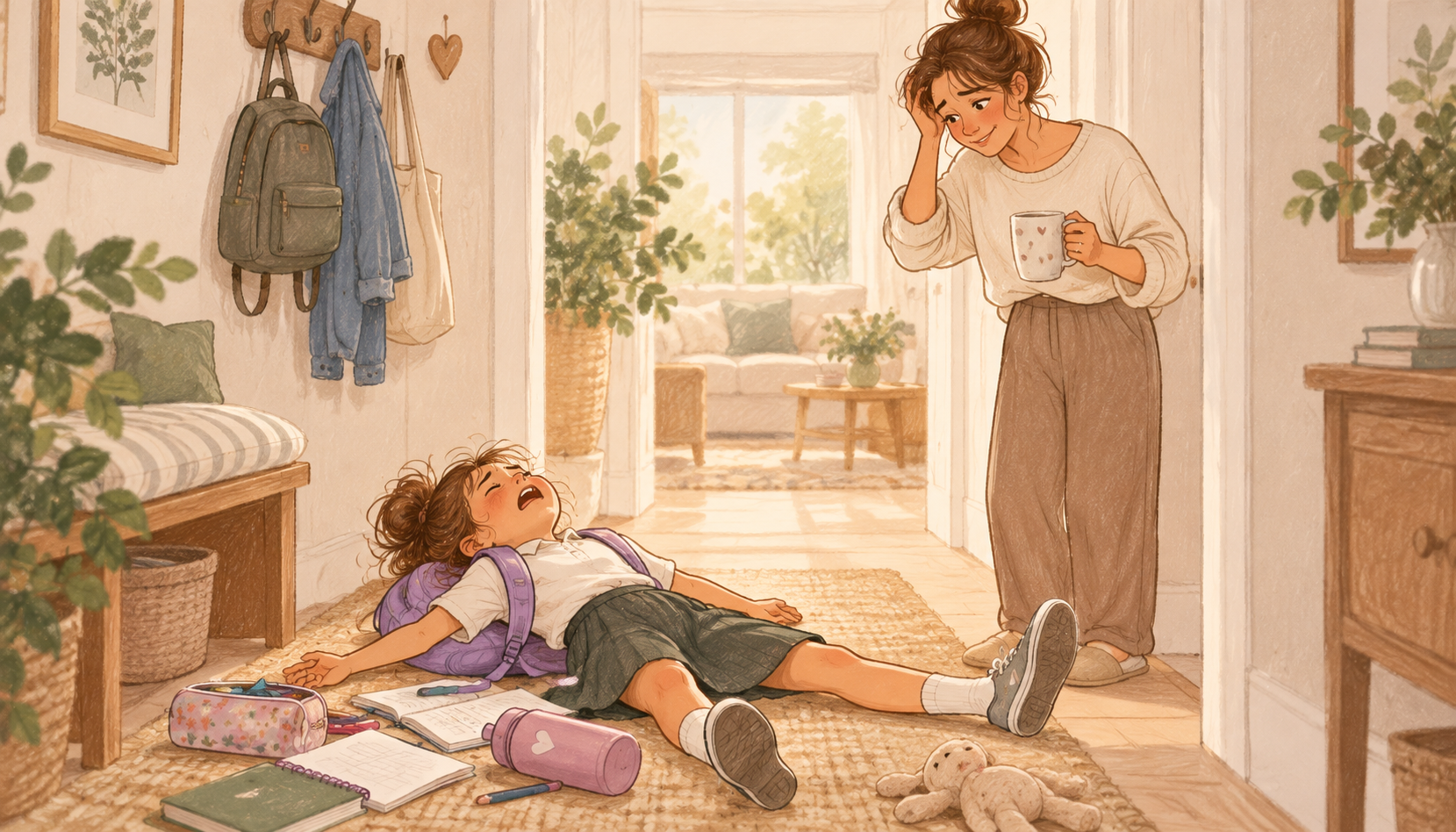
Meltdowns, Tiredness and “I Don’t Want to Go to School”: What’s Happening to Your Child in September
Kids back to school, parents back to drinking their coffee while it’s still hot.
The first few days of a new school year often go surprisingly well. Your child happily heads off with a new backpack, sees friends they have not seen all summer, wants to tell them everything that happened, compare who has changed and how, and there is also that very particular pleasure of opening a brand-new notebook and using pens and pencils that, so far, nobody has lost, broken, or chewed.
If your own school years were not associated with constant fear, bullying, or some particularly difficult experiences, you may remember that feeling yourself. Even if you did not wake up on the first day of school thinking, “God, I’ve missed maths so much,” seeing your friends after the summer, finding out where everyone had been, who had grown, and who this new teacher was could still feel genuinely exciting.
Parents are often fairly optimistic at this point too. Of course, especially if your child is starting school for the first time, there is anxiety because you want to know how everything will go, whether they will like the teacher, whether they will make friends, and whether they will cope with the new routine. At the same time, somewhere in the back of your mind, a beautiful little plan is already beginning to take shape: now that school has started, I’ll finally be able to concentrate properly on work, organise my day, sign up for yoga, meet a friend, and perhaps even finish a cup of coffee while it is still hot.
The first week is usually not the hardest academically either. Children are getting to know each other, remembering the rules, receiving books and materials, teachers are explaining how things will work, everyone is gradually settling into the rhythm, and it can seem as though everything is going wonderfully.
And then, one lovely morning, this same cheerful child looks at you and says, “Mum, I’m not going back to school.”
This is usually the point where the parental mind begins demonstrating some fairly creative ways of adapting to reality. If your child doesn’t want to go to school after the first few days or weeks, that alone does not necessarily mean that something terrible has happened.
Some parents can move within seconds from “my child doesn’t want to go to school today” to “Oh God, I’ve raised a lazy person who will never want to do anything, will achieve nothing, and will somehow be living under a bridge in ten years.” The opposite extreme sounds more like, “Right, that’s it, somebody is definitely hurting them, the classmates are awful, the teacher is awful, and I need to go to that school tomorrow and sort this out immediately.”
This is probably a good moment to breathe in through your nose, breathe out through your mouth, and first try to understand what is actually happening to your child, because it is entirely possible that nothing catastrophic has happened.
They are simply adjusting.
And school adjustment can look much less calm, graceful, and reassuring than parents might have hoped.
What is actually landing on a child all at once in September?
From an adult perspective, many parts of school life can seem fairly simple. You just need to wake up a little earlier, go to school, sit through a lesson, listen to the teacher, complete a task, avoid interrupting, remember that PE is tomorrow, somehow navigate your classmates, and preferably not lose half your stationery by Wednesday.
The problem is not that any single one of these tasks is extraordinarily difficult. The problem is that a child has to adapt to a large number of changes at the same time.
Their sleep and rest schedule changes, cognitive demands increase, they have to sustain attention for longer, remember instructions, switch between subjects, understand the expectations of different teachers, negotiate with peers, find their place in the group, deal with assessment and comparison, cope with their own mistakes and disappointment, and manage dozens of other small things that may each look insignificant to an adult.
But there are a lot of them, and they are all happening at once.
And this is not only about children who are starting school for the first time. A child going into fifth, seventh, or ninth grade already knows perfectly well what school is, but after several months of a much freer summer routine, they still have to return to a system with a fixed wake-up time, lessons, homework, social expectations, and plenty of things they did not choose for themselves.
It is also worth remembering that this transition does not happen because one morning your child wakes up and says, “Right, Mum, I’ve had enough rest now. I’m ready for discipline and algebra.”
September simply arrives, and the whole system starts again.
If you have moved countries, you probably know roughly what this feels like
Think about your own experience for a moment. For anyone who lives abroad or has gone through a major move, there is a fairly relatable analogy.
Even when relocating was something you wanted, even when you like the new country and made the decision yourself, at first you constantly spend energy on things you would never previously have thought twice about.
Where do people buy the groceries you are used to? How do you pay this bill? How do you find a doctor? Does public transport actually work here? Do you need a car? Where do people look for flats? Who do you call if something breaks? How do you book a dentist? How does the school system work? Where do you buy that completely ordinary thing you used to pick up back home without even thinking about it?
If you also start working in a new environment, there may be a new team, different expectations, another way of communicating, and even if the company itself has not changed, the people and context may still feel completely new.
None of these tasks looks catastrophic on its own. But when there are twenty or thirty of them at the same time, by the end of the day you can feel completely exhausted even though you have not exactly spent the day doing hard physical labour.
Something very similar happens to a child.
It is not necessarily because school is bad or because the child is unable to cope, but because adaptation itself takes a lot of energy.
Which reactions can be normal during the first few weeks?
Against this background, a child may become more tired, more irritable, cry over things they previously handled calmly, protest more often, say they hate everything, refuse to go anywhere after school, or simply want to spend more time at home.
Some children may find it harder to concentrate, some may struggle to fall asleep, while others want to sleep much more than usual. Appetite can change, and headaches or stomach aches may sometimes appear. This does not necessarily mean that the child is making them up, because tension and stress can genuinely show up in the body.
This is one of the ways school-related stress in children can sometimes present itself, particularly while they are still settling back into a new routine.
Children respond differently depending on temperament, age, overall workload, and the way their nervous system handles stress. One child becomes sadder, another becomes angry, another starts arguing with everyone around them, while somebody else simply becomes extremely tired and wants everyone to leave them alone.
There is a simple gym analogy here. Imagine that you have not exercised for ten years and then, one Monday, decide that today you are training legs, arms, back, abs, glutes, and anything else you can squeeze in before the gym closes. The next day, you are probably going to be fairly horrified by how sore everything feels.
That soreness does not mean exercise is harmful or that your body is broken. You simply gave it a level of strain it had not yet adapted to.
A child can experience something similar. Not long ago, this lovely relaxed human being might have been sitting on the beach, swimming, wandering around, reading a book, or scrolling on their phone unless they happen to have one of those parents with very firm opinions about screen time, and now suddenly they have to wake up at a specific time, get ready, enter an environment full of rules and people, listen, remember things, behave in certain ways, and ideally learn something at the same time.
It is important not to conclude from this that structure is bad. Discipline has its place, and school can be perfectly good, but these are still structures that the child has to fit back into.
Why is your child wonderful at school and then falls apart at home?
There is another thing that particularly puzzles parents. The teacher says, “Your child is wonderful, so calm, polite, listens well, behaves beautifully,” while you look at them thinking, “Are you absolutely sure we are talking about the same child?”
Because this wonderful child comes home and, within the first twenty minutes, manages to argue with you about lunch, homework, a younger sibling, the wrong cup, and the very existence of humanity.
After-school meltdowns, or sudden bursts of anger at home, can be especially confusing when teachers describe what sounds like a completely different child.
If you think back to when your child was very small, you may already have seen something similar. A parent leaves the child with a grandparent, nanny, or family friend for a few hours, comes back, and hears that everything was wonderful: the child played, ate, laughed, and caused absolutely no trouble.
Then Mum walks through the door, and suddenly there are two hours of crying, shouting, and drama.
That does not necessarily mean Mum is doing something wrong. Often, the reason is precisely that the child feels safe with her.
Children are actually quite good at reading social expectations and understanding how they are supposed to behave with different people. At school, a child may spend the whole day holding it together, controlling their reactions, following rules, responding appropriately to the teacher, negotiating with classmates, suppressing some impulses, and trying to learn something on top of all of that.
When they come home, their system finally gets permission to loosen that control a little, because these are their people, everything is familiar, this is a safe place, and they know they are still loved here.
And sometimes everything that accumulated during the day gets released onto the people closest to them.
We may not particularly enjoy it, but if we are being fair, adults sometimes do almost exactly the same thing. We can spend an entire day being professional and polite, speaking calmly to colleagues and clients, not snapping at anyone, and then come home and start grumbling at our family because a cup is in the wrong place or because the children have somehow chosen this exact evening to ask twenty questions at once.
Adults already have much greater capacity to control impulses and regulate their emotional state, while children are still developing those skills. Over time, they will learn to understand what is happening inside them, put emotions into words, avoid dumping everything immediately onto the people closest to them, and find other ways to release tension.
But for now, sometimes it looks exactly like this.
When might this be more than ordinary adjustment?
Of course, not every difficulty should be explained away with, “It’s just adjustment, let’s wait.”
What matters is the duration and intensity of the reaction and, most importantly, whether things are gradually becoming at least a little easier for the child.
If several weeks have passed and things are not improving or are actually getting worse, if the child regularly complains of severe headaches or stomach aches before school, develops significant problems with sleep or eating, becomes very withdrawn, stays persistently low even at weekends, or begins to fear a particular person or situation, then it is worth looking more closely at what is happening.
The same applies when refusing to go to school becomes persistent and very intense, or when you can see that the child’s state is not simply uncomfortable but is seriously affecting everyday life.
At that point, alongside talking with the child, it may be useful to speak with the teacher and, if necessary, consult a psychologist to understand what exactly is going on.
The aim is not to panic every time a child says, “I don’t want to go to school,” but it is also not to ignore everything.
Children do not have to adjust beautifully, quietly, and in a way that is convenient for adults. Some children move through this period very smoothly, some complain for a few weeks, some cry, and some announce to the entire family that the education system has clearly run its course.
None of that automatically means something has gone terribly wrong.
What matters more is not expecting a perfect reaction, but trying to notice what is difficult for your child right now and whether, little by little, they are beginning to cope with it.
Ready to find your therapist?
Understanding therapy is one step. The next is finding someone you feel comfortable talking with about what matters to you. Start with a free 15-minute online introductory call.
15 minutes · online · free