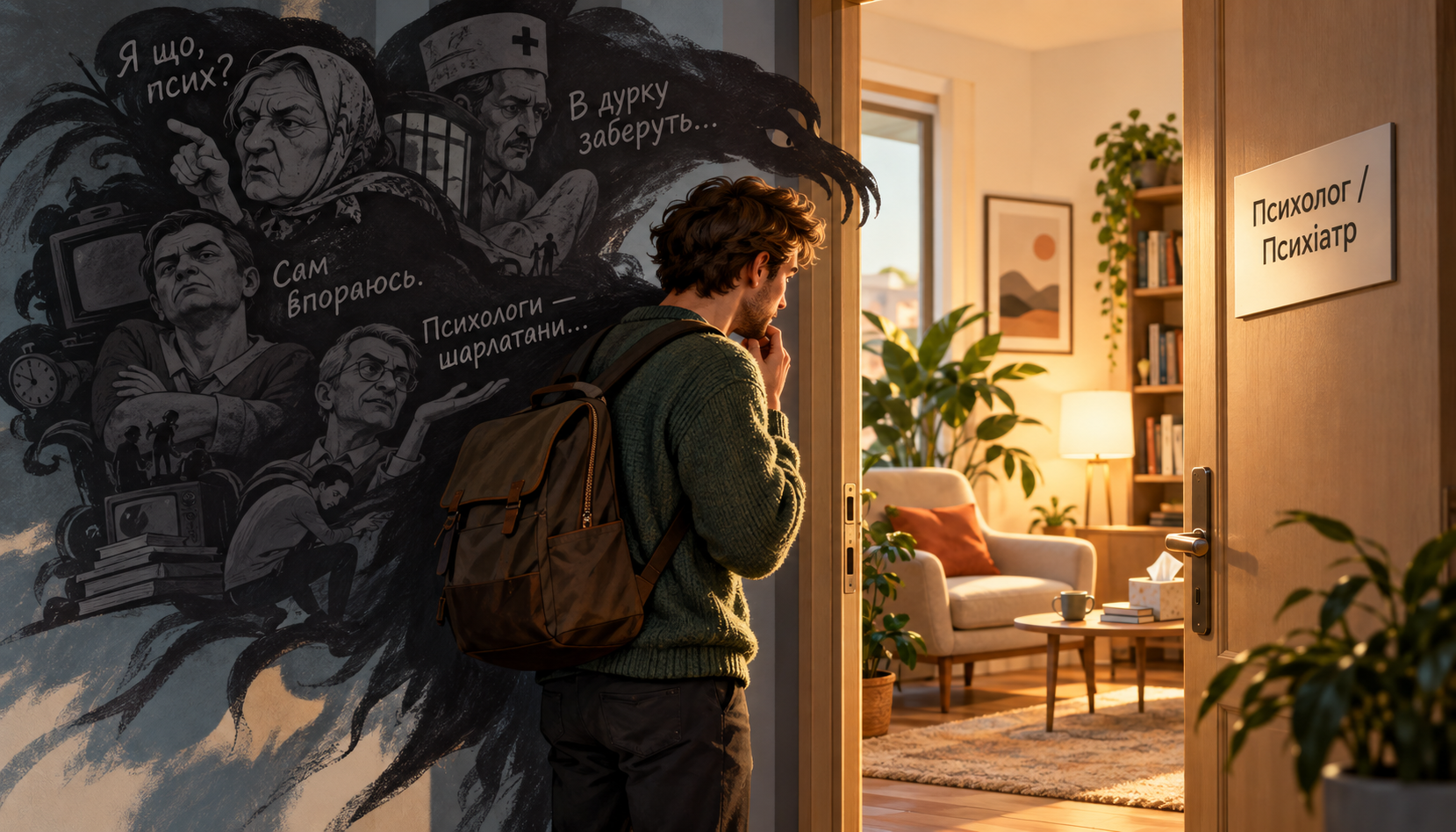
“Am I Crazy?”: Why We’re Still Afraid of Psychologists and Psychiatrists
Many of us still have a rather complicated relationship with mental health.
A person can spend months sleeping badly, living with constant anxiety, snapping at loved ones, having a beer almost every evening just to finally relax, or doing something else for years that clearly makes them feel worse. And yet the thought of seeing a psychologist, and especially a psychiatrist, can sometimes feel more frightening than the symptoms themselves.
Because asking for help means admitting that I am not coping. And then there is a whole menu of thoughts to choose from: why would I go there, am I some kind of weakling who cannot deal with this on my own? Or: what am I, crazy? Only crazy people go to psychologists. And, of course, the classic one: psychologists are all frauds anyway, they will just take my money and will not help me at all.
But when we talk about why people are afraid to seek help from a psychologist or psychiatrist, it is worth looking a little deeper into our history.
World War II veterans
Soviet culture gradually created a very recognizable image of the war veteran: a brave person covered in medals, flowers, ceremonial speeches, and a victory everyone was expected to be proud of. Happy Young Pioneers bring them flowers, everyone applauds. Curtain.
But behind that picture was a much more difficult question: what happened to the people who came back from the war looking very different from the kind of victorious heroes society wanted to see?
People who had lost limbs, suffered severe injuries, lived with chronic pain or neurological problems. Hospitals and residential institutions for people with disabilities existed, and some veterans ended up in them. One of the best known was the institution on Valaam Island. I will add a link at the end of the article for anyone who wants to read more about it.
The important thing to understand is that archival research shows that medical and social support for severely disabled veterans often, to put it mildly, fell far short of what they needed. There were poor-quality prostheses, bureaucracy, housing shortages, difficult conditions inside institutions, and gradual social marginalization. In places such as Valaam, conditions could be even more disturbing.
Physical injuries, however, were at least visible.
The psychological consequences of war were much harder to deal with.
PTSD did not yet exist as a diagnosis
A person could return from the front physically intact but wake up from nightmares, constantly expect danger, react intensely to sudden sounds, become irritable or aggressive, struggle with crowds, drink heavily, or seem emotionally disconnected from the people closest to them.
The diagnosis of post-traumatic stress disorder did not yet exist. It is a bit like that stupid joke: the ass exists, but there is no word for it.
Soviet psychiatrists used different concepts. They spoke about neuroses, psychogenic reactions, the consequences of concussion, nervous exhaustion and other disorders.
It is not that psychiatrists failed to notice the consequences of war altogether. They did notice them, study them and write about them. The problem was different: scientific interest in a phenomenon did not mean that large numbers of veterans had access to adequate, high-quality help.
Historian Robert Dale, who studied the post-war adjustment of veterans, writes that it was mainly the most severe cases of psychological trauma that had a realistic chance of entering the treatment system.
Most people coped however they could. They returned to work and family life, rebuilt cities and villages, and sought support among other former soldiers. Some gradually adjusted quite well. Others lived for years with nightmares, outbursts of anger or constant hypervigilance. For many people, alcohol became a way of numbing something they had no other way of managing.
It is also important to understand that widespread alcohol abuse was connected, among other things, with these undiagnosed consequences of trauma and what we would now recognize as PTSD among some veterans.
At the same time, it is important not to make the opposite mistake: a severe experience of war does not automatically mean that a person will develop a mental disorder.
A potentially traumatic event affects a person, but what happens afterwards depends on many factors: the event itself, previous experience, individual psychological characteristics, available support and the conditions to which a person returns. Modern research also shows that most people exposed to potentially traumatic events do not develop PTSD, although the risk is considerably higher in the context of war.
Punitive psychiatry
Soviet psychiatry had a well-documented practice of using psychiatric diagnoses, involuntary hospitalization and treatment as tools of repression.
This practice existed before the war, but it became particularly systematic from the late 1950s through the 1960s, 1970s and 1980s, although individual cases are documented much earlier.
People who came into conflict with the authorities, openly criticized the Soviet system, engaged in human rights activities or simply became “inconvenient” could be sent for psychiatric assessment, diagnosed and involuntarily hospitalized. Historical research documents thousands of such cases, as well as a much larger grey area involving people who entered the system after conflicts with local authorities, complaints, or behaviour that was considered abnormal or politically unreliable.
One of the most notorious diagnoses was so-called sluggish schizophrenia.
Its criteria could be interpreted so broadly that excessive principled behaviour, “reformist ideas”, a strong concern with justice or political activism could become part of a psychiatric description of a person.
This made psychiatric diagnosis an exceptionally convenient instrument of repression: instead of simply punishing someone, the state could declare them mentally ill and therefore cast doubt on the validity of everything they said.
And it is important to understand what “ending up in a psychiatric hospital” could actually mean in this context.
In Soviet psychiatric hospitals, a person might not know how long they were going to be detained or when their condition would next be reviewed. Formally, patients were supposed to undergo regular reassessment, but studies describe cases in which these reviews took place irregularly or even without the patient being present. Family members might receive little or no meaningful information about the treatment or the doctors responsible for it.
The forced administration of high doses of powerful antipsychotic medication is also documented, including the use of injections not only as treatment but as punishment for disobedience or violations of institutional rules.
In special psychiatric hospitals, political prisoners could be held alongside people who had committed serious crimes and had been found not criminally responsible because of mental illness. Researchers describe physical violence by staff or other patients, rigid discipline, a profound sense of helplessness in the face of the system and uncertainty about when, or whether, a person would be released.
So people were afraid of very concrete things: involuntary hospitalization, a diagnosis without genuine medical grounds, indefinite detention, powerful medication used as a means of coercion, isolation from loved ones, loss of social status and the possibility that once a person had been labelled “mentally ill”, their own words would no longer be taken seriously.
Sometimes even proving that you were healthy became paradoxically difficult. If a person continued insisting that they had been hospitalized unjustly, that insistence itself could be interpreted as another symptom of illness.
One of the best-known examples is that of General Pyotr Grigorenko, a World War II veteran. After he began openly criticizing the Soviet authorities, he was declared mentally ill and involuntarily detained in psychiatric institutions.
A young Kyiv psychiatrist, Semyon Gluzman, independently analyzed Grigorenko's case and concluded that there were no grounds for such a diagnosis. For taking this position, Gluzman himself was sentenced to seven years in labour camps followed by three years of exile.
The fear outlived the system
The Soviet Union no longer exists, and modern psychiatry and psychotherapy operate according to very different principles.
But culture does not change overnight.
Experience is passed down not only through history books. It is transmitted through family stories, conversations between neighbours, rumours, jokes, warnings and simple phrases such as: “Don't say things like that or they'll lock you up in a mental hospital,” “Only crazy people go to psychiatrists,” or “Better not tell anyone.”
This is how the stigma surrounding mental disorders and distrust of the psychiatric system gradually developed.
Researchers studying post-Soviet psychiatry explicitly note that memories, and even rumours, about the punitive use of psychiatry left behind a long-lasting distrust of psychiatric diagnoses and treatment.
Research on mental health stigma in Ukraine also links contemporary social distance from people with mental disorders and reluctance to engage with mental health services, in part, to the Soviet legacy of large closed psychiatric institutions and the social isolation of their patients.
Several generations lived in an environment where hiding psychological vulnerability could be safer than revealing it.
Admitting that there was a problem could mean not only receiving help, but also facing stigma, losing social status, losing a job, losing other people's trust and, in some cases, much more.
So the rule becomes very understandable:
“Better to cope on your own and not let anyone see that you are struggling until you absolutely cannot hide it anymore.”
And once again, we are living through war
This is precisely why this history is particularly relevant to us now.
The psychological consequences of war can be very different. Losing loved ones, being injured, living under constant threat to life, combat experience, occupation, captivity, forced displacement or spending years under bombardment cannot leave a person entirely untouched.
But there is no equals sign between “something terrible happened to me” and “I have a mental disorder”.
The same event can have very different consequences for different people. Some will recover relatively quickly. Others may need years. Some will develop PTSD, depression or another disorder; others will not.
What happens after the event also matters enormously: whether a person has safety, housing and work, who is around them, whether they have support and whether they are able to regain at least some sense of control over their own life.
And perhaps one of the things we can do differently as a society this time is stop demanding that a person must be either a decorated hero who is completely fine or “crazy”.
There is an enormous space of ordinary human life between those two extremes.
A person can be strong and still struggle for a period of time. They can work, raise children, joke with friends and at the same time experience panic attacks or nightmares. They can survive a war and need psychotherapy. They can need a psychiatrist and medication.
None of these things means that there is “something fundamentally wrong” with them.
Seeking help today should mean exactly what it is supposed to mean.
Getting help.
Sources and further reading
- Robert Dale, Coming Home: Demobilization, Trauma and Postwar Readjustment in Late Stalinist Leningrad — on post-war adjustment, the psychological consequences of war, stigma and the ways veterans found to cope. Robert Dale's research
- Robert van Voren, Political Abuse of Psychiatry: An Historical Overview — an overview of the mechanisms through which psychiatry was used for political purposes in the Soviet Union. Political Abuse of Psychiatry
- Nanci Adler, Semyon Gluzman, Soviet Special Psychiatric Hospitals — describes what confinement in special psychiatric hospitals could mean for people detained there for political reasons. Soviet Special Psychiatric Hospitals
- A study of mental health stigma among Ukrainian adults and the influence of the Soviet psychiatric legacy. Mental health stigma in Ukraine
Ready to find your therapist?
Understanding therapy is one step. The next is finding someone you feel comfortable talking with about what matters to you. Start with a free 15-minute online introductory call.
15 minutes · online · free